When a beam is loaded, bending moment and shear force are developed at all section of the beam. In Unit 2, we have already learnt the methods of determining shear force and bending moment in a beam section under the given loading conditions.
Previously, we have seen the bending stress distribution at any cross section of the beam. Now, we will study the shear stress distribution at any section of the beam.
Shear Stress Distribution in Beams
The vertical shear force at any section of a beam produces shear stress at that section that varies along the depth of the section. This vertical shear stress is accompanied by a horizontal shear stress of equal magnitude, known as complementary shear stress. So at any point in a cross section of the beam, there is a vertical shear stress and a horizontal shear stress of equal magnitude of τ.
These two shear stresses cause the diagonal tension and compression inclined at 45 degrees to the horizontal.
Let us consider a element of length dx of the beam and subjected to bending moments M and M+dM shown in fig.
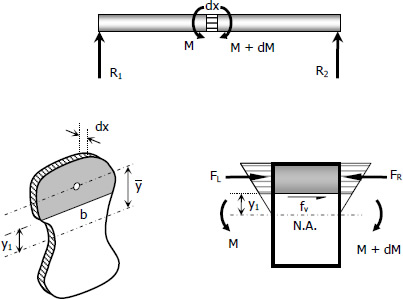
Let dA be an elementary area at a distance y from the neutral axis.
a = ∑dA - is the area of the beam above upper shaded portion of the beam
sy - is the bending stresses at a distance y from the neutral axis is equal to [My/I] and [(M+dM)y/I] For the upper shaded portion of the beam,
FL - the total normal forces due to the bending stresses on the left side of the beam.
FL = ∑dA.sy = ∑dA.(My/I) --- (1) FR - the total normal forces due to the bending stresses on the right side of the beam.
FR = ∑dA.sy = ∑dA.[(M+dM)y/I] ---(2)
fv - the net unbalanced force of FR and FL forces will be resisted by the shearing force, acting at the boundary surface between the shaded and the un shaded portions.
fV = τ b.dx ---(3)
For equilibrium of the upper shaded portion
FL+fV–FR = 0
fV = FR - FL
Substitute the the values in above equation
fV = τ b.dx
= ∑dA.[(M+dM)y/I] - ∑dA.(My/I)
τ.b.dx = ∑dA.y(dM)/I
τ = ∑dA.y/Ib . (dM/dx)
But dx/dM = Shear Force (Vx) at the section.
(Rate of change of bending moment is represents the shear Force at the section )
and ∑dA.y = a.y' = Q , represents the first moment of an area of the shaded section about N.A.
The Shear stress at a layer is
τy = Vxay'/ Ib = VxQ/ Ib
Where
a = Area between the extreme face of beam and the plane at which the shear stress is τy
y' = Distance of the centroid of area ‘a’ from N.A
Q = a.y' = the first moment of an area of the shaded section about N.A.
Vx = Shear force at the cross-section.
I = Moment of Inertia of the beam cross section about N.A.
b = Width of the fiber at the shear plane
Note:
1. The maximum shear stress occurs at the neutral axis and is zero at both the top and bottom surface of the beam.
Shear flow has the units of force per unit distance.
2. For a rectangular section, the maximum shear stress τmax = 1.5 τave
The average shear stress
τave = Shear force / Area of cross section

3. For a circular section, the maximum shear stress τmax = 4/3 τave

The shear stress distribution across a circular section is parabolic curve.
4.In case of triangular section , the shear stress is not maximum at N.A. The maximum shear stress is located at a height of h/2

The maximum shear stress in Triangular section
τmax = 1.5 τave = 3Vx/bh
The shear stress at N.A in Triangular section
τNA = 4/3 τave = 8Vx/3bh
The shear stress distribution for unsymmetrical sections is obtained after the calculating the N.A.
Excellent presentation
ReplyDelete
ReplyDeleteThis is a blog to watch for sure. I think you have a really awesome writing style by the way. Very easy to read. Your blog design is so clean too! Thank you all the hard work!
Iron workers